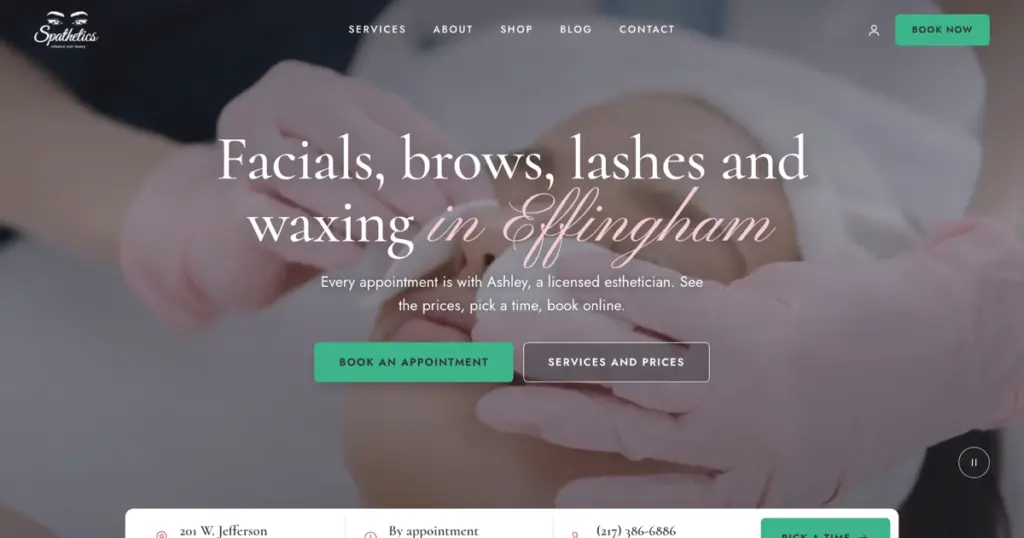
Spathetics is a one-esthetician studio in downtown Effingham. Ashley opened in 2023, and her clients book facials, brows, lashes and waxing online. We built her site and brand identity in 2024. On October 1 and 2, 2026, we moved it onto the framework behind every site we build now, without taking the booking calendar offline for a minute.
This post is the build log. The short version: the page now reads every price and appointment length straight from the booking system, so they can never disagree again. The homepage dropped from 8.7 MB to 1.3 MB. And an accessibility scan that failed 746 checks on the old site now passes clean.
Key takeaways
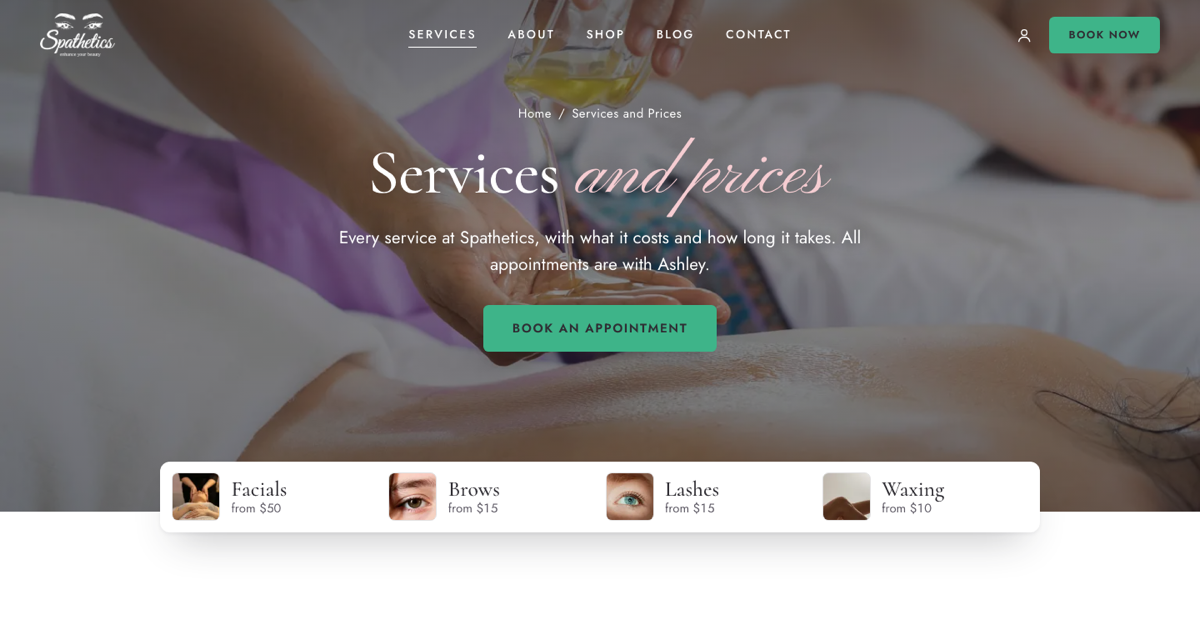
- The old site and the booking system disagreed on nine services. Now the service page reads price and duration from the booking calendar, so the price on the page is always the price you are booked for.
- The homepage weighed 8.7 MB, most of it a 7.5 MB stock video the browser fetched twice. The video is now 2.3 MB (0.8 MB on phones), loads after the page, and has a pause button.
- Mobile speed scores: the services page went from 74 to 98, the shop from 69 to 92, and the booking page from 56 to 75. The homepage scores 100 on desktop with its largest element painted in 0.6 seconds.
- Accessibility went from 746 failing checks across six rules to zero violations on 16 pages at desktop and phone widths.
What was wrong with a site that looked fine
From across the room, the old site was fine. The brand was right, the photos were pleasant, and the Book button worked. The review, captured on October 1, found the problems underneath:
- Six appointment lengths on the site differed from the booking system, three were blank, one service could not be booked at all, and two services you could book had no page.
- Service pages were 36 to 168 words pasted from a chat tool, with the chat window’s own markup still in the content.
- Every Book button opened the generic form at step one. No price or time sat near any of them.
- There was no local-business structured data at all: no address, hours, services or prices in a form Google can read.
- Every page title was “Name – Spathetics”, most pages had no description, and the homepage had six H1 headings.
- White text on the brand mint measured 2.6:1 contrast, well under the 4.5:1 minimum. The accessibility scan failed 746 checks.
- A caching setting made every first visit load each page twice, which cost 4 to 5 seconds on a phone and 13 seconds on the booking page.
- The homepage video’s poster frame pointed at the video file itself, so the browser downloaded 7.5 MB twice.
The design was not the problem, so we kept the formula: the video hero, the script accents, the rose and mint palette Ashley chose in 2024. Everything under it changed.
The booking system is the source of truth
The single most important decision was where the price lives. The old site stored its own price and duration on each service page, separate from the booking system, and they drifted. Nine of them were wrong by launch day.
Now each service page is linked to its entry in the booking calendar and reads the price and the duration from there on every load. The text fields on the page are only a fallback. What a client is booked for is the truth, and the page reports it.
Three smaller changes finish the job:
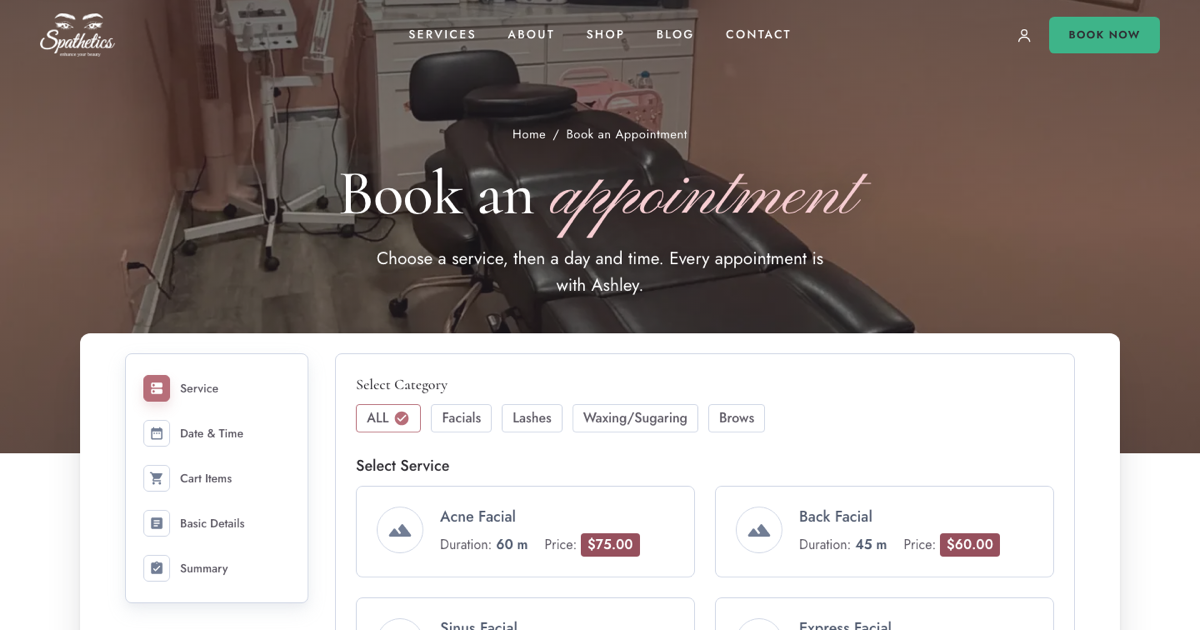
- “Book this service” on every service page opens the calendar on the date-and-time step for that service, instead of at step one.
- A Book button sits in the header on every page, and phones get a fixed booking bar at the bottom of the screen.
- Two bookable services that had no page got one. One service that cannot be booked online now says “call to book” instead of a dead button.
Launching without touching the calendar
Clients book on this site every day, which ruled out the usual approach of building a copy and pushing the whole thing live. The live database stayed the source of truth before, during and after the launch. The cutover pushed the new theme files and ran a set of scripts against the live database to create the new pages, redirects and settings. The local copy’s database was never pushed up. A full backup of the old site and database was taken first.
One lesson from the clone is worth sharing with anyone who works on a booking site. A copy of a booking site can email and text real clients: the booking plugin has its own mail connection, separate from WordPress’s. Before loading a single page on the clone, we disabled the scheduler, pointed the plugin’s mailer at a dead end, blanked its mail tokens and switched off the SMS and payment add-ons.
Speed, weight and the video
Measured on the live site with Lighthouse, mobile, before and after.
| Page | Old score | New score | Largest paint, old | Largest paint, new |
|---|---|---|---|---|
| Home | 82 | 93 | 3.8 s | 2.0 s |
| Services | 74 | 98 | 8.1 s | 2.3 s |
| Shop | 69 | 92 | 8.7 s | 3.2 s |
| Book an appointment | 56 | 75 | 18.5 s | 4.4 s |
On desktop the homepage scores 100 with its largest element painted in 0.6 seconds. The booking page is still the heaviest, because the booking widget is a third-party app that ships its own scripts. Going from 56 to 75 there is real progress, not a finish line, and it is the next thing on the list.
The weight came off by removing things. The old site loaded 690 KB of stylesheets and used 3 to 4 percent of them, plus an icon font, a mega menu plugin and a slider. The new site loads two stylesheets totaling about 11 KB compressed, self-hosts its fonts, draws its icons inline and does not load the store plugin’s stylesheets on pages that are not the store. The video was re-encoded from 7.5 MB to 2.3 MB, with a 0.8 MB version for phones, a real poster frame and a pause button, and it starts downloading only after the page is usable.
Accessibility and search
Two rules fixed most of the accessibility failures. Small text never sits on the brand rose, and the mint buttons carry dark ink instead of white. Add real landmarks, one H1 per page, named social links and visible focus styles, and the scan went from 746 failing checks to zero on 16 pages at desktop and phone widths.
For search, every page now has its own title and description, generated from the live price where there is one. Each page carries one structured-data graph: the business as a beauty salon with its address, hours and price range, each service with its price, the questions and answers, and the breadcrumb trail. Utility pages like the cart and thank-you page are kept out of the index. Four service addresses that did not match their service were renamed, with the old addresses redirecting, and each group of services has a hub page at its own address.
Her photos, not stock
The site launched with placeholder photos. The same day, Ashley sent photos of herself and the studio from her phone, and they replaced the placeholders on the homepage, the About page, the Contact page and the booking page. Phone photos arrive in a wide color profile with the location of the photo baked into the file, so each one was converted, cropped to the shape of its slot and stripped of its location data before it went up.
Frequently asked questions
Did online booking stop during the launch?
No. The booking calendar and its database were never taken offline. The launch changed the theme and the pages around it.
Why read prices from the booking system instead of typing them on the page?
Because two copies of a price will drift. The old site had nine services where the page and the calendar disagreed. One copy, read live, cannot.
What about the online shop?
It stayed. The store plugin’s own stylesheets were restyling every image on the site, so the shop is now styled directly and its scripts load only on store pages. The shop page scores 92 on mobile, up from 69.
Is the booking page fast now?
Faster, not fast. The booking widget is a third-party app with its own scripts. The page went from 56 to 75 on mobile and from 18.5 seconds to 4.4 seconds to its largest paint. Trimming it further is the next job.
How long did it take?
Two days, October 1 and 2, including the review of the old site, several design rounds and the launch. The site had already been built once, in 2024, so the facts, the brand and the service list were all in hand.
Is this the same framework behind your other sites?
Yes. Every site on the Hands-Off Website plan runs on it, and so does every custom build.
The point
For a service business that books online, the website has one job: get the client to the calendar with the right price and the right time in front of them. The old Spathetics site made that harder than it looked. The new one reads the truth from the calendar and gets out of the way.
If your site and your booking or ordering system have ever disagreed, or you are not sure, a free website review is the place to start. We check the whole site, not just the homepage, and tell you what we find.