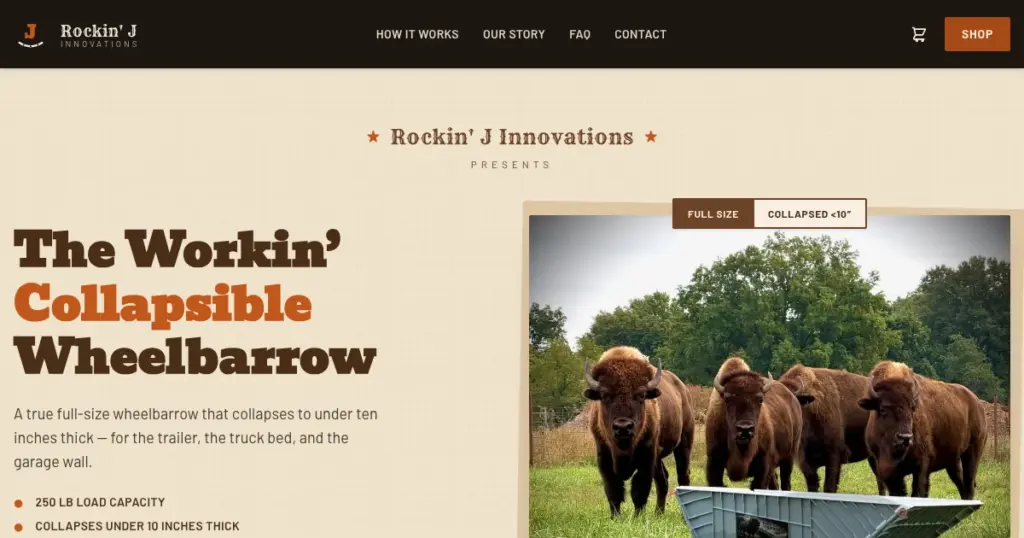
Rockin’ J Innovations makes one product: The Workin’ Collapsible Wheelbarrow, a full-size, 250 lb wheelbarrow that collapses to under 10 inches thick. The idea came on the drive home from a horse show finals, with the stall wheelbarrow tied to the trailer roof because it fit nowhere else. Months of cardboard prototypes, cut and taped at home, turned it into a steel and poly wheelbarrow that folds flat in a few minutes with bare hands.
The family came to us in early September with a finished product, printed retail cartons and a patent on the way. They did not have a website or a logo file. The site went live at rockinjinnovations.com on October 30, the day they approved launch. This post is the build log: what the site had to do, what we built, how the reviews went and what the live site scores.
Key takeaways
- One site serves two audiences. Shoppers get the homepage, the product page and six landing pages. Store buyers get a wholesale page with specs and a line-sheet request.
- The QR code printed on every carton opens a full assembly manual page, and the address is built so a scan never ends on an error page.
- When the family needed the logo for new box art, the website lockup became their brand mark, delivered as print-ready files and an 11-page brand guide.
- The review site was up 10 days after kickoff. Launch was a domain switch, not a migration, and it passed all 47 launch checks with zero accessibility violations.
Where Rockin’ J started
Rockin’ J Innovations is a new company, separate from the family’s other businesses. Ryan and Janet ran Rockin’ J Customs, a grain facility maintenance company, for 22 years, and their daughter Larisa runs an equine rehab business. They compete in ranch sorting, team penning, cutting and reining cow horse, so they know the problem the wheelbarrow solves from hauling to shows themselves.
The website had more jobs than most:
- Sell direct to four kinds of customer: homeowners with small yards, horse and show-livestock haulers, construction crews, and farm and ranch users.
- Give retail buyers, big-box chains included, a reason to call and a credibility check before they stock a product they have never seen.
- Give the QR code printed on the carton and the assembly manual somewhere to land.
- Be ready before the product is. Full production starts in January, general availability is February, and pricing is announced at launch.
A design drawn from the box
The strongest brand asset the family had was their retail carton: Western artwork, a bison, parchment and kraft colors, distressed type. We built five homepage designs as working pages, and the family picked the Western one. Its palette and type come from the packaging, so the site and the box look like they came from the same company.
One color needed more work than it looked. The brand orange measured 3.9:1 against the site’s cream background, which fails the contrast standard for text under 24px. Rather than change the brand color, we kept it for large type and fills and added darker shades of the same orange for buttons, links and small text. Every text color on the site passes, and the orange still reads as the brand.
One site, two audiences
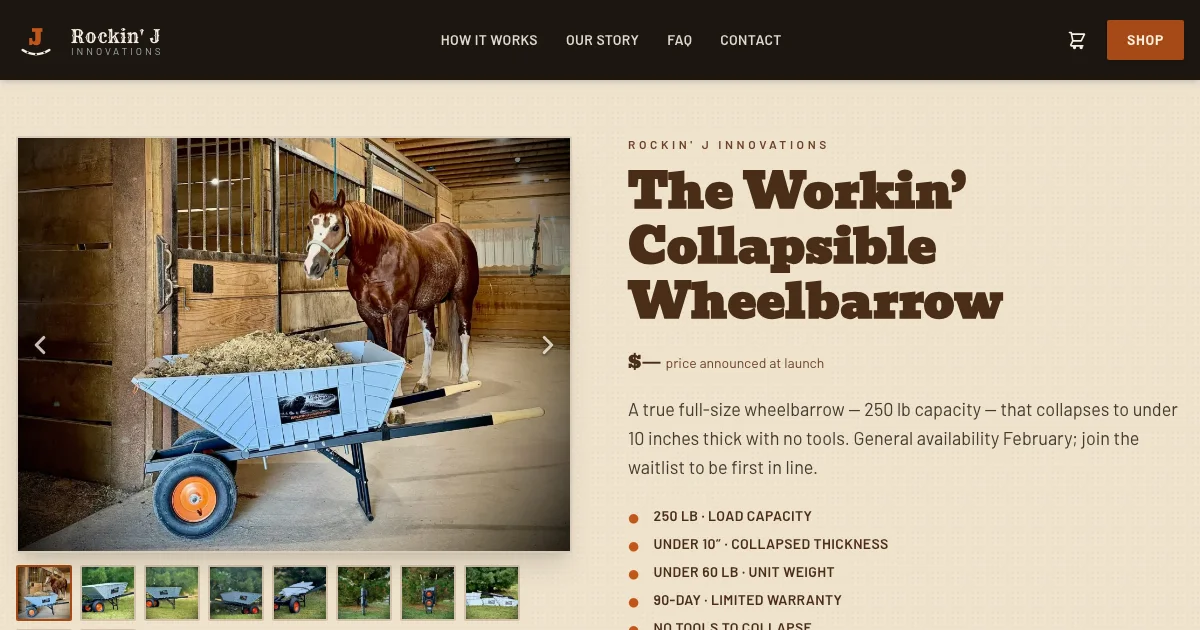
Shoppers own the homepage and the main menu. The product page carries the photos, the specs and the questions people ask before they buy. Six landing pages each take one situation (a horse-trailer tack area, a show-livestock stall, a small yard, a construction truck bed, a farm and ranch, a garage wall) and lead with a photo of the wheelbarrow in that use. Each one answers the questions that kind of buyer asks.
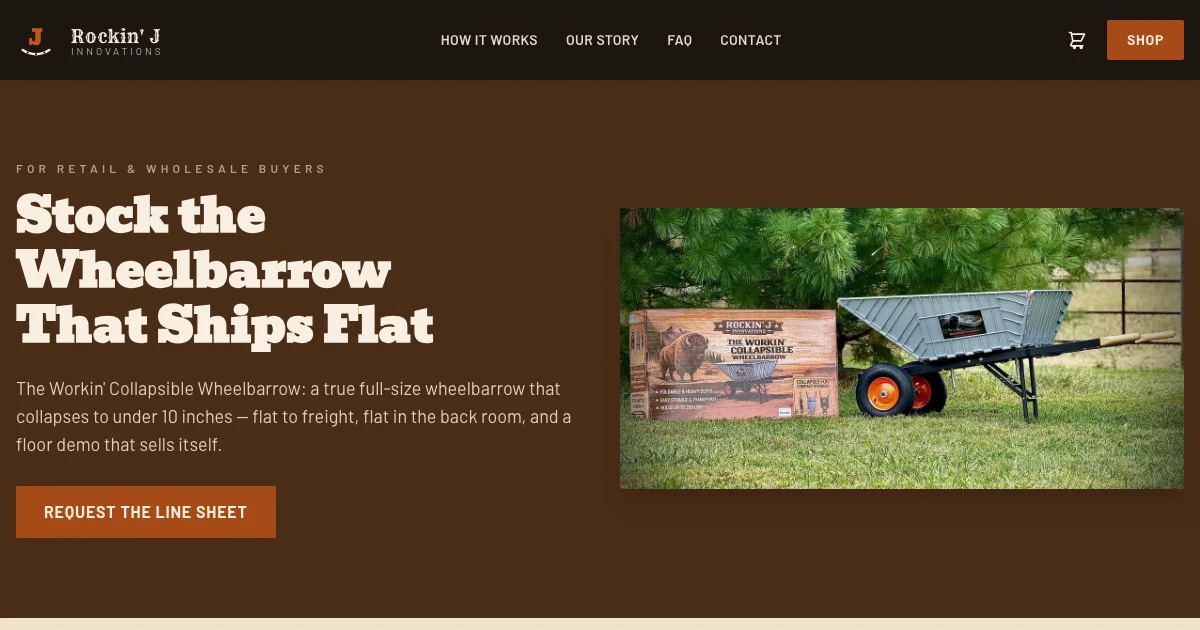
Store buyers get their own page, linked from the footer. It covers what a buyer checks before taking a meeting:
- The case for shelf space, in the family’s words: no other rigid wheelbarrow in the category collapses, it ships flat, and an associate can demo it on the floor in minutes.
- A product facts table: capacity, weight, collapsed size, materials, colorway, warranty and packaging.
- The timeline to first shipment, a buyer FAQ and a form to request the line sheet.
Where trade terms are still being set, the page says so and offers to send real numbers by email. We would rather a buyer wait a day for a real figure than read a placeholder.
The retail work reached past the website, too. When Janet set up the GS1 barcode for the product, the registry asked for a permanent product image address, and the domain had no website yet. We put a holding page on the domain with the product image at its own address, and put the same file in the WordPress install so that address survived launch unchanged. Barcode registry links are as permanent as anything printed on a box.
Pages for what is printed on the box
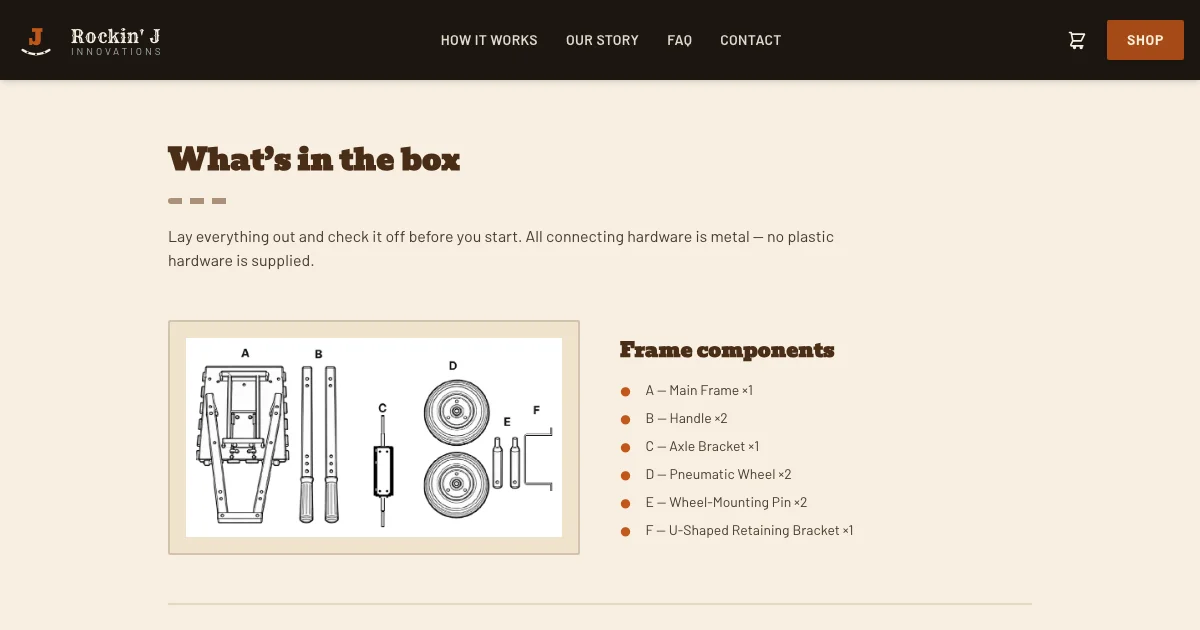
Printed things cannot be updated. The cartons and the assembly manual carry a QR code that opens rockinjinnovations.com/instructions, and the cartons were printed before the site launched. So we treated that address as part of the product.
- The manual is a real web page: the parts list, six steps to assemble, three steps to fold it flat, safety, maintenance and troubleshooting. We transcribed the steps instead of rewriting them, because it is a safety document for a 250 lb load. Changes to it come from the family.
- The printable PDF is still offered, small enough to open on a phone, and we checked that the QR code on its cover still scans to the same address.
- If the manual page is ever unpublished by accident, the printed address falls back to the How It Works page with a temporary redirect, so a scan from a box never lands on an error page.
- A second QR code, for promo signs at shows, goes through a short link that tags every scan in analytics. The family can see how many visits the signs bring in, and a new campaign never means reprinting a sign.
Brand files they could hand a printer
The family never had a logo file. The site’s header lockup, an orange J on a rocker with “Rockin’ J” set in Rye and “Innovations” in Barlow, was drawn for the web. When Janet asked for the website logo to use on new box artwork, it became the official brand mark. We redrew it as print-ready outlines in four colorways (for light backgrounds, for dark backgrounds, black and white) as SVG, vector PDF and large PNG files, with a plain-English note on which file goes to the printer.
When she asked which fonts the logos use, we answered with an 11-page brand guide: the logos and when to use each one, clear space and minimum size, the palette in HEX, RGB and CMYK, the fonts and their jobs, photo guidance, voice and the key product facts. It is the document a printer, a marketing partner or a retailer’s vendor setup will ask for.
Three rounds of review
The review site went up on September 14, 10 days after kickoff, and the family reviewed it three times. Larisa sent marked-up screenshots each round: 17, then 27, then 14. Each round was applied and deployed to the review site so the family could check the real pages. A few of the changes reached further than one line:
- She flagged the word “barrow” on its own in 17 places. We found 45 across the pages and the code and made every one “wheelbarrow”.
- The compartment in a horse trailer is the “back tack” to the people who use one. The copy uses their word.
- The site had listed gray, black, brown and orange, which read like a menu of color options. There is one colorway, so the site now says “one color, exactly as shown on the box”, including in the product’s structured data.
Twelve deploys later, the site was finished and waiting on one thing: the patent.
Launch day
On October 30, Janet wrote that the patent had issued, Patent No. 12,774,021, and gave the go-ahead. The site went live that afternoon.
- A domain switch, not a migration. The review site had run on the production server since September, so launch pointed rockinjinnovations.com at it. Nothing was copied, so nothing the family reviewed could go missing. The old review address now forwards to the real domain.
- A waitlist that keeps every name. Checkout opens once the price is set and payments and shipping are connected, so for now the store runs as a waitlist. The form plugin only emails signups and does not keep them, so we added a Waitlist screen in the admin that saves every signup and exports the list to a spreadsheet in one click.
- Email that arrives. Site and store email sends from the family’s own domain through an authenticated mail service, with SPF and DKIM passing, so form notifications and, later, order emails do not land in spam.
- Found from day one. Google Analytics and Search Console were set up, the sitemap went to Google, and all 18 pages went to Bing and other search engines through IndexNow. The robots file welcomes AI search crawlers by name, and 56 questions across 10 pages are marked up as FAQ structured data.
- Checked before anyone else saw it. A launch script ran 47 checks against the live domain, covering every page, the redirects, the manual page the QR codes open and the barcode image address, and all 47 passed. An accessibility scan found zero violations at desktop and phone widths.
What the live site scores
Measured against the live site on October 30 with Lighthouse, on desktop.
| Page | Performance | Accessibility | SEO |
|---|---|---|---|
| Homepage | 94 | 100 | 100 |
| Product page | 94 | 100 | 100 |
| Wholesale page | 98 | 100 | 100 |
Accessibility and SEO also score 100 on a phone. The server answers in 30 to 60 milliseconds.
What comes next
The waitlist is open now. Full production starts in January, and the wheelbarrow is generally available in February. Before then the family sets the price and connects payments and shipping, and checkout switches on. The store is already built, so opening it means adding the price and connecting the accounts, not starting a new project. Changes keep going in after launch, the same as on every site we run.
Frequently asked questions
How long did the build take?
The family signed on September 4. Five homepage designs were ready on September 9, the review site was up on September 14, and three rounds of client review followed. The site went live on October 30, the day the family approved launch.
Can you build a store for a product that is not for sale yet?
Yes. Rockin’ J’s store runs as a waitlist until pricing is set. The product page shows the photos, specs and FAQs, with a waitlist form where Add to cart will go. Every signup is saved in the admin and exports to a spreadsheet, so the family has a list to email the day ordering opens.
Why does a new product need a wholesale page?
Because store buyers look before they call. A buyer hearing about a new product wants to see that it is real, that the packaging is finished and that someone will answer. The wholesale page gives them the specs, the packaging details and the timeline, plus a form to request the line sheet.
What happens to the QR codes if a page moves?
Nothing breaks. The printed address is a short path on the family’s own domain. If the manual page is ever moved or unpublished, the address forwards with a temporary redirect, so it can point somewhere new later without reprinting a single carton.
Who owns the domain?
The family does. rockinjinnovations.com was registered in their own account from day one, and they share access with us.
Is this the same framework behind your other sites?
Yes. Every site on our e-commerce subscription and Hands-Off Website plans runs on it, which is why a fix made once reaches every site.
The point
A new product needs more than a store. Rockin’ J needed a site that sells to shoppers, answers store buyers, catches the QR codes printed on its boxes and holds a waitlist until the product ships. Building all of that in from the start is why launch day was a domain switch and not a scramble.
If you have a product to launch, our e-commerce subscription covers the store, the hosting and the changes after launch in one monthly plan. If you already have a site, start with a free website review. We will tell you what is broken and what it is costing you, whether or not you hire us to fix it.