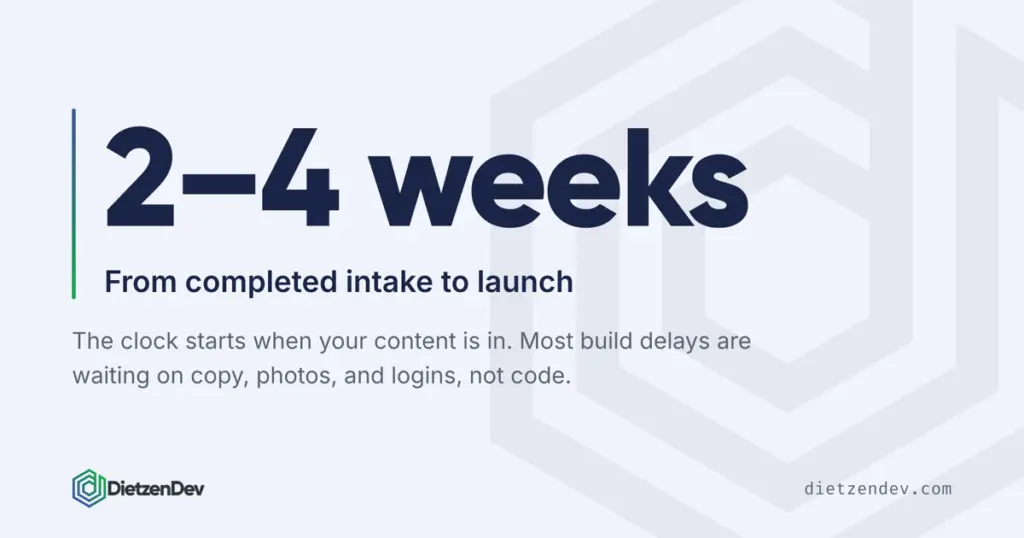
Ask five developers how long a website takes and you will get answers ranging from two weeks to six months, usually with no explanation of the difference. If you are a small business owner trying to plan a launch around a busy season, a loan, or a marketing push, that is not good enough. So here is a realistic website build timeline: for most small business sites, we launch in 2 to 4 weeks from completed intake. And the single biggest variable is not the code. It is how quickly your content is ready. This post walks through what happens each week, why builds stall, and exactly what to have ready so yours does not.
The short version
- Typical launch is 2 to 4 weeks from completed intake, not from the first phone call.
- The clock starts when your content is in: copy, photos, logos, and logins.
- The phases are intake, design, build, review, and launch.
- The most common delay in any build is waiting on content, not development.
- Custom builds vary with scope, so the timeline is fixed in the proposal before work starts.
What “completed intake” actually means
Completed intake means we have everything needed to build: your page copy (or at least detailed notes), photos and logo files, your domain and hosting logins, and a decision-maker who can give feedback within a couple of business days. The 2 to 4 week clock starts there, not at the first conversation.
This distinction matters because it is where most timeline confusion comes from. A build quoted at “three weeks” that takes three months usually did not run long in development. It sat waiting for content. Separating the intake phase from the build phase makes the schedule honest, and it puts part of the schedule in your hands, where it belongs.
What a realistic website build timeline looks like, week by week
Week 1: intake and discovery
We start with a structured intake: what the business does, who the customers are, what the site needs to accomplish, and which pages it needs. You gather content during this phase, and we review whatever exists today (your current site, your Google Business Profile, your competitors). The clearer this week goes, the faster everything after it moves.
Weeks 1 to 2: design
With content in hand, we design the site around your actual material rather than dropping your text into a template. Real headlines, real photos, real services. You review the design and give one consolidated round of feedback. Consolidated is the key word: five small emails over two weeks moves slower than one thorough reply in two days.
Weeks 2 to 3: build
The approved design gets hand-coded into a working WordPress site. This is the phase people assume takes the longest, and it usually is not. With a settled design and finished content, development is the most predictable part of the whole schedule. We build for speed from the start rather than trying to bolt performance on at the end.
Weeks 3 to 4: review, revisions, and launch
You review the working site on your phone and your computer, we make final revisions, and then we handle the launch checklist: redirects from old URLs, SSL, analytics, search engine indexing, and a speed check with Google’s PageSpeed Insights. Launch itself is usually a same-day event once everything is approved.
Why builds run long (it is almost never the code)
Key insight: a website build is rarely late because of development. It is late because someone is waiting on photos, copy, or a password.
The three delays we see most, in order:
- Content. Page copy and photos are the number one bottleneck we see. If writing is the obstacle, say so early. Writing the copy can be part of the project instead of the thing that silently stalls it.
- Feedback loops. A review that takes two days keeps the schedule. A review that takes two weeks resets it, because the project loses momentum on both sides.
- Scope changes. “While we’re at it, can we add online ordering?” is a fine question, and the honest answer is that it changes the timeline. Deciding scope up front is what makes a fixed schedule possible.
How to keep your build on schedule
Have these ready before the build starts and the 2 to 4 week window is very achievable:
- Domain registrar login (or tell us where the domain lives)
- Logo files, ideally the original vector versions
- Photos of your actual business, team, and work (real photos outperform stock)
- Page copy, or notes detailed enough for us to work from
- A list of your services with real prices, or ranges you are comfortable publishing
- One decision-maker who can reply to review requests within 2 business days
Subscription vs. custom build: how the timelines differ
We build sites two ways, and the timeline conversation is different for each.
| Decision point | Website subscription | Custom build |
|---|---|---|
| Price | $299/mo, no setup fee | From $5,000, fixed price |
| Scope | Custom-built site, up to 8 pages | Whatever the project needs |
| Typical timeline | 2 to 4 weeks from completed intake | Set in the proposal, based on scope |
| After launch | Hosting, security, and edits within 2 business days, ongoing | 30 days of post-launch support, then you self-manage |
The subscription timeline is predictable because the scope is defined: up to 8 pages, launched in 2 to 4 weeks once intake is complete. A custom build might be a similar size or it might be a large WooCommerce store, so we scope it first and put a specific timeline in the fixed-price proposal. Either way you get a date, not a shrug.
Frequently asked questions
How long does it take to build a small business website?
For most small business sites, 2 to 4 weeks from completed intake. That means the schedule starts once your content, photos, and logins are in, not at the first phone call. Larger custom projects take longer, and the timeline is set in the proposal before work begins.
What is the biggest cause of website build delays?
Content. Waiting on page copy, photos, and logins delays more builds than any technical problem. The fix is to treat content gathering as its own phase before the build clock starts, and to name one decision-maker who can respond to review requests within 2 business days.
Can a website launch in under two weeks?
Sometimes, when the scope is small and every piece of content is ready on day one. But we would rather quote 2 to 4 weeks and hit it than promise ten days and miss. If you have a hard deadline, tell us at intake and we will say plainly whether it is realistic.
Do we need our content written before starting?
No, but the build cannot finish without it. If writing is the bottleneck, we can work from detailed notes and draft the copy as part of the project. What matters is deciding at intake who is writing what, so the site is never sitting finished except for words.
What happens after the site launches?
On the website subscription, launch is the beginning: hosting, security, and content edits within 2 business days are included ongoing. On a custom build, you get 30 days of post-launch support and training, and then the site is yours to manage.
What if we already have a website?
A rebuild follows the same timeline, with one addition: we map your existing pages and set up redirects so you keep the Google visibility you have already earned. Your current site stays live and untouched until the new one is ready, so there is no gap.
The bottom line
A realistic website build timeline for a small business site is 2 to 4 weeks from completed intake, with intake, not development, deciding whether that holds. Get your content, photos, and logins ready, name one decision-maker, and the schedule takes care of itself.
If you are planning a build and want a straight answer on scope and timing, start with a free website review. We will look at what you have now and tell you what we would fix first, within 2 business days.