
Rachel Precision builds competition and hunting rifles in Canton, Mississippi. Randy Rachel has spent more than 40 years at the lathe, and shooters running his barrels have placed at world championships. The site runs on the same hand-coded framework behind every site we build, and its current version went live on October 1, 2026.
This post is the build log: what the review found, what we kept, what we changed, and what the live site scores. The short version is that a homepage that weighed 13.4 MB now weighs 1.2 MB, every product and price came across untouched, and every claim on the site now has a source a reader can click.
Key takeaways
- The old homepage weighed about 13.4 MB, most of it a 7.6 MB autoplay video with no poster frame. The new homepage is 1.2 MB.
- 70 products and 6,066 WooCommerce variations came across exactly as they were. Randy now edits prices from one table instead of opening variation panels.
- Every proof claim has a source. “#1 and #9 in the world” is gone. “4th in Open Division at the 2026 IPRF World Championship”, with a link, is in.
- 116 URLs checked with zero failures, zero accessibility violations at desktop and phone widths, and 100 for accessibility, best practices and SEO on every page we measured.
What the review found
Rachel Precision has what most small gunsmith sites lack: a real shop, real proof and real parts. The problems were in the plumbing and the claims. Our review of the old site, captured on September 28, found:
- Links broke on the paths a buyer uses most: the hunting tile on the homepage and the main button on the Actions page.
- Every product page offered “Add to cart” on a store with no payment gateway and zero orders, ever.
- Two product descriptions leaked text that was never meant to publish: one told buyers to email another company’s FFL inbox, another ended with a chatbot’s “let me know if you’d like any adjustments.”
- 103 of 113 pages had the wrong number of H1 headings. 720 of 1,536 images had no alt text.
- The site claimed “#1 and #9 in the world” and a “national magazine” recognition with no source for either.
- The only build-request form had no rimfire option, even though the testimonials on the page came from rimfire shooters.
- Google did not return the site for a single rimfire, RimX or NRL22 rifle builder search.
None of that is a design problem. It is what happens to a site that gets edited for two years without anyone checking the whole thing. So we did not restyle it. We moved it onto the same hand-coded framework we use for every custom build and fixed the plumbing.
Keeping the catalog, changing the plumbing
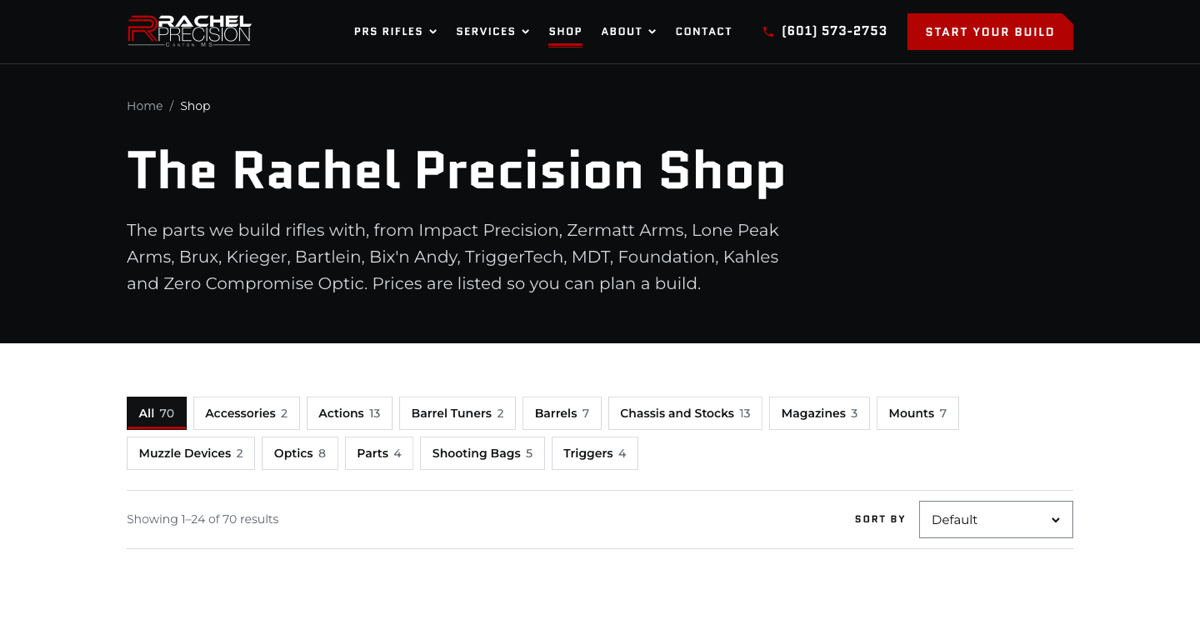
The catalog is the part of the site Randy has put the most work into: 70 products (8 simple, 62 variable), 6,066 variations, 12 categories and 23 attributes. One chassis alone has 1,600 variations. We did not restructure any of it.
What changed is how the store behaves and how Randy runs it:
- Catalog mode, enforced in code. Nothing is purchasable, the cart and checkout redirect to the shop, and every product shows a “Call to order” button with the phone number. WooCommerce stays installed, so checkout can be switched on later by removing a few lines.
- One price sheet. A new admin screen lists all 70 products in one table. Randy types a price, hits save, and it writes through WooCommerce’s own functions. We tested it against the 1,600-variation chassis and confirmed that nothing else in the product record changed by a single byte.
- An owner role. Randy’s login shows prices, products, services, pages, posts, media and form submissions. It hides plugins, themes, store settings and anything else that can take a site down. A PDF owner’s guide, with screenshots of his actual admin, shows him how to do each job.
Proof with a source, or no proof
The rule for the new site was simple: a claim gets a source a reader can open, or it comes off. That rule changed more copy than anything else.
The old “recognized as a top rifle builder in a national magazine” turned out to be Precision Rifle Blog’s 2024 “What the Pros Use” survey, where Rachel Precision appears among the gunsmiths used by 3 of the top 200 PRS Open shooters. That is a real, strong fact, so the site now says exactly that and links to it.
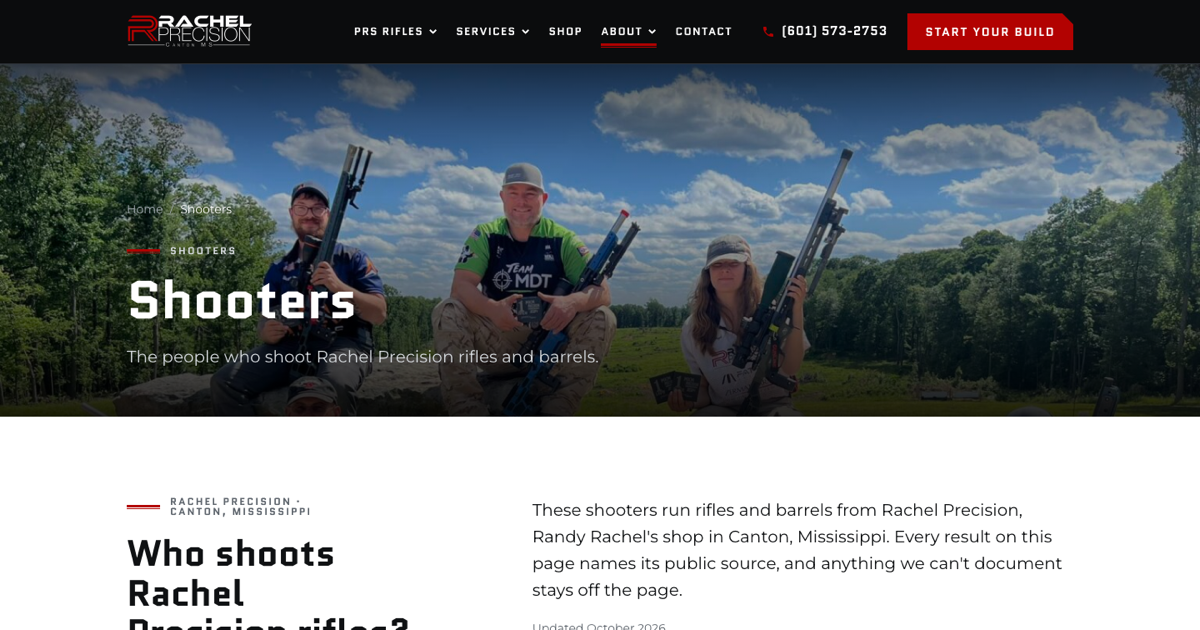
The new Shooters page lists 11 shooters who run Rachel Precision rifles or barrels, each with the series, year and division of the result and a link to the organization that recorded it. A few examples:
- Jeff Guerry, 4th in Open Division at the 2026 IPRF Precision Rifle World Championship, and on the Team USA Open roster.
- John Boyken, first-place Seniors team at the 2025 IPRF Rimfire World Championship in England.
- Matt Stiner, 2nd in Open at the 2025 IPRF Rimfire World Championship and the 2024 PRS Tactical Division Champion.
- Dakota Wright, 2nd in Juniors at the 2025 IPRF Rimfire World Championship.
Researching the roster taught us something worth passing on. A shooter’s PRS profile lists a “gunsmith” line in their gear, and it is the best independent proof of who builds their rifle. It confirmed six names and contradicted three that had been on the old site. Those three came off. Two surnames were also spelled wrong on the old site; the official rosters settled them.
Built to be found for the searches that matter
Randy wants to be found for “PRS rifle builder” and “PRS .22LR rifle builder”, not just his own name. The old site ranked for neither. We added:
- Two answer pages, one for centerfire PRS rifles and one for .22LR, built from the same template, with the sourced proof above and a plain spec plate of what a build includes.
- A FAQ page whose structured data is generated by the same function that renders the questions, so Google and the page can never disagree.
- One business entity in the structured data: a single local business typed as a gunsmith, with Randy as a person who works there, instead of three overlapping records with the same address.
- Citations as links. A source name in parentheses does nothing for search or AI answers until it is a link, so every parenthetical now is one.
- A safety net for alt text. Product images with no description in the media library now default to the product name, which took 720 blank images to zero.
- Redirects for every retired URL. Old testimonial pages go to the Shooters page, three thin 2024 blog posts merged into the service pages they described, and the cart and checkout go to the shop.
What the live site scores
Measured against the live site on October 2 with Lighthouse, on desktop.
| Measure | Old site | Now |
|---|---|---|
| Homepage weight | 13.4 MB | 1.2 MB |
| Images without alt text | 720 of 1,536 | 0 |
| Pages with the wrong number of H1s | 103 of 113 | 0 |
| Performance (desktop) | not measurable | 98, largest paint in 1.0 s |
| Accessibility | 720 missing alts, no focus styles | 100 |
| Best practices | 100 | |
| SEO | 100 |
The accessibility checker ran against 39 URLs at desktop and phone widths, with the menu open and forms in their error states, and reported zero violations. A link check across 116 URLs reported zero failures.
Phone scores are the next job. A caching setting on the server makes a phone’s first visit load the page twice, and it is on the list to switch off. The page itself is already light enough.
What it took from the owner
Less than you would think, and that was the point. Randy answered an email with seven new shooters, a handful of build-sheet changes and some wording he wanted. We applied all of it with a script, tested the script on a local copy, then ran it against the live site the same day. His remaining questions, like shop hours and lead time, do not hold anything up: wherever he has not answered yet, the site drops that sentence rather than printing a guess.
Frequently asked questions
Did any products or prices change?
No. All 70 products and 6,066 variations are exactly as they were. What changed is the screen Randy uses to edit prices.
Why is there no cart?
Rachel Precision has never taken an online order, and every build starts with a phone call. The old site offered “Add to cart” on a store with no payment gateway. The new one says “Call to order” and means it. Checkout can be turned on later by removing a few lines of code.
Can the owner edit the site himself?
Yes. His login shows prices, products, services, pages, posts, media and form submissions, and nothing that can break the site. The owner’s guide walks through each task with screenshots of his admin.
What happened to the old page addresses?
Every one of them still works. Pages that moved or merged redirect to their new home, so nothing Google already knew about the site was thrown away.
How long did the work take?
The old site was cloned on September 28, the new theme was built and tested on September 29, and the site went live before the end of that week. Randy’s first round of revisions was live on October 1.
Is this the same framework behind your other sites?
Yes. Every site on the Hands-Off Website plan is built on it, which is why a fix made once shows up on every site.
The point
A site can have great raw material and still be losing customers to broken links, unsourced claims and a 13 MB homepage. Rachel Precision had the proof. It just needed a site that stated it honestly and loaded fast enough for anyone to read it.
If your site is a couple of years old and nobody has checked the whole thing since launch, start with a free website review. We will tell you what is broken and what it is costing you, whether or not you hire us to fix it.