If your business website was built by a do-it-for-me company like Hibu, you have probably hit the same wall Weber’s Clothing did. You cannot edit your own site. Every change goes through a third party. The page looks almost finished, but not quite. And when a customer searches for your store on Google, you are nowhere near the top of the map.
Weber’s Clothing is a family menswear and tuxedo shop in Teutopolis, Illinois, a few minutes east of Effingham. It has been on Main Street since 1892. In June 2026 we ran a free, four-angle review of their Hibu site, then rebuilt it from scratch and reviewed the new one the same way. This post puts the two side by side: the same store, graded by the same shopper, copywriter, designer, and engineer, three weeks apart. The Hibu website went from a C- to an A-. Here is exactly what changed, and why it matters for any local business stuck on a template.
Key takeaways
- Before: a Hibu-hosted Duda template. Overall grade C-, with a cookie banner over the headline, a main button that led to a page reading “the company is not yet configured,” and zero structured data for Google.
- After: a fast, hand-coded site with no template and no page builder. Overall grade A-, and a perfect 100 across Performance, Accessibility, Best Practices, and SEO on Google’s mobile PageSpeed test.
- The rebuild added a complete local-business profile Google can read, real photos of the store and owners, and a working “reserve a fitting” form.
- The lesson: a do-it-for-me template can look fine and still quietly cost you customers and search visibility. A fast site you own fixes both.
The before: a 125-year store on a Hibu template
The old site ran on Duda, resold and hosted through Hibu. That is the tell of a do-it-for-me builder: the content was delivered through Hibu’s CDN, and the page markup used Duda’s template framework. The owner did not have hands on the site. Any update meant coordinating with a third party, so the site rarely reflected what was actually happening in the store.
Our reviewers graded it a C- overall, with one honest line at the top: a 125-year store hidden behind a half-finished template. The foundation was better than a lot of small-business sites. It had HTTPS, clean page titles, a working sitemap, and the same name, address, and phone number on every page. But the experience a real customer hit first looked unfinished.
A few specifics, all verified against the live HTML at the time:
- A cookie banner covered content on every single page. On the homepage it clipped the hero headline so “One-Stop Shop for Men’s Apparel” read as broken. On the contact page it sat directly on top of the store hours, so a customer literally could not see when Weber’s was open.
- The main call-to-action led to a broken page. The header button said “Request Service,” and it opened a page that rendered the literal text “The company is not yet configured.” A dead, error-looking page, live and linked right in the navigation.
- Every photo was a generic stock model. No storefront, no staff, no actual racks of suits and tuxedos. For a beloved 125-year-old local shop, that is the whole advantage left on the floor.
- A free Gmail address was the public contact. It sat in the footer of every page, in plain source, even though the business already owned its domain.
- Google was told almost nothing. There was zero structured data on the homepage. More on why that one matters below.
The raw material for a great site was all there: real heritage, real brand names on the tuxedo page, two genuinely good customer reviews. It was buried under template defects and stock photos.
The scorecard, side by side
We grade every review from four angles: a shopper, a copywriter, a designer, and a web engineer. Here is the same store, scored on the same eight categories, before and after the rebuild.
| What we graded | Before (Hibu) | After (rebuild) |
|---|---|---|
| Design (desktop) | C | A |
| Mobile experience | D+ | B+ |
| Messaging and copy | C- | A- |
| Conversion path | D | A- |
| Technical SEO base | B- | A |
| Local SEO and trust | D | A |
| Proof and credibility | C- | B+ |
| Performance | C+ | A |
| Overall | C- | A- |
The biggest jumps are the ones that decide whether a local store gets found and gets the call: conversion path (D to A-) and local SEO and trust (D to A).
What was actually broken (and what it cost)
A C- is not a disaster on its own. The problem is what each defect quietly costs a store that lives on walk-ins, weddings, and prom season.
The broken button cost trust at the worst moment. A shopper who clicks “Request Service” and lands on “the company is not yet configured” does not think template glitch. They think nobody finished this, and then they wonder how carefully you would handle their wedding order.
The cookie banner cost the first impression. Most of Weber’s visitors are on a phone. On mobile, the banner truncated headlines and covered the hours. The first thing a phone visitor saw looked like a page that was malfunctioning.
The missing structured data cost search visibility. This is the one most owners never see. The homepage carried no LocalBusiness structured data, the machine-readable block that tells Google your address, hours, phone, and that you are a store at all. Without it, you are trusting Google to guess. For a brick-and-mortar shop that lives on “near me” and map results, that is the headline miss.
The stock photos cost the one edge a chain cannot copy. “Local, 125 years, trusted” was asserted in text with no visual proof. Meanwhile two real, specific customer stories were stranded on inner pages where almost no one would read them.
The rebuild: what “done right” looks like
We did not touch up the old site. We replaced it with a hand-coded site, no template and no page builder, built around one sharp idea.
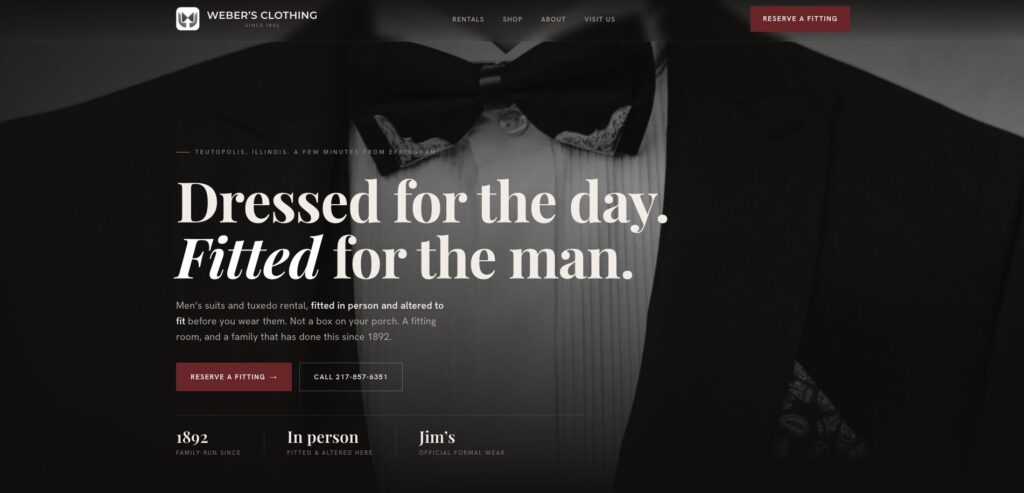
A real design system, held across the whole site. Tall serif headlines with one italic word, an oxblood accent, small-caps eyebrow labels, and real photography, applied consistently on every page. Our designer moved it from a C to an A. It reads more current and more premium than almost any small-town menswear site, which raises a shopper’s confidence before they read a word.
One message a competitor cannot lift. The whole site leans on a single believable wedge: we do the part a website can’t. Not a box on your porch, but a fitting room and a family that has done this since 1892. The homepage frames the entire choice on Weber’s terms, in-person at Weber’s versus ordering online, and it is persuasive against both online rental sites and a faceless chain an hour away.
The real story, finally told. The rebuild dug up the actual history the old “125 years” claim was rounding off: founded in 1892 as the H.J. Weber Company by Henry J. Weber, back when customers sometimes paid “a hog,” handed to Tony Weber in 2004, and run by Brad Weber today. That earns the heritage instead of just asserting it. More than 130 years, told as a story with names and dates.
Real proof, in the open. Actual photos of Brad and Tony Weber, of Tony selecting a jacket at the rack, and of the Main Street storefront. Real, attributed Google reviews on the page, including one from a parent who got her 12-year-old measured “just in time,” which is perfect proof for the exact timing fear a nervous prom or wedding customer has.
A conversion path that works for everyone. The new “reserve a fitting” form asks for just a name and phone, with a smart “what is the fitting for?” dropdown, a collapsible “add a few details,” a “what to expect” sidebar, and the hours and address right there. There is a “rather just call?” fallback for people who would rather talk. It even works with JavaScript turned off. The old loud button led to a broken page. The new one captures the lead and points it at a booked fitting.
Under the hood: speed and local SEO
This is where a hand-built site pulls away from a template, and where most of the durable value lives.
Speed. The old Duda pages were light but unoptimized: no modern image formats, nothing lazy-loaded. The rebuild is a static site with no render-blocking CSS or JavaScript, analytics deferred so it never blocks the page, and images served as WebP with width and height set and below-the-fold images lazy-loaded. The numbers from our engineer’s review:
| Performance signal | Before (Hibu) | After (rebuild) |
|---|---|---|
| Homepage weight over the wire | 23 KB gzipped (89 KB raw) | 14 KB gzipped (65 KB raw) |
| WebP images site-wide | 0 | 41 |
| Lazy-loaded images | 0 | 9 |
| Render-blocking external CSS/JS | present | none |
| Performance grade | C+ | A |
WebP images run around 30% smaller than the equivalent JPEG or PNG, and a faster page directly helps Core Web Vitals, which Google uses as a ranking signal and which keeps phone visitors from bouncing.
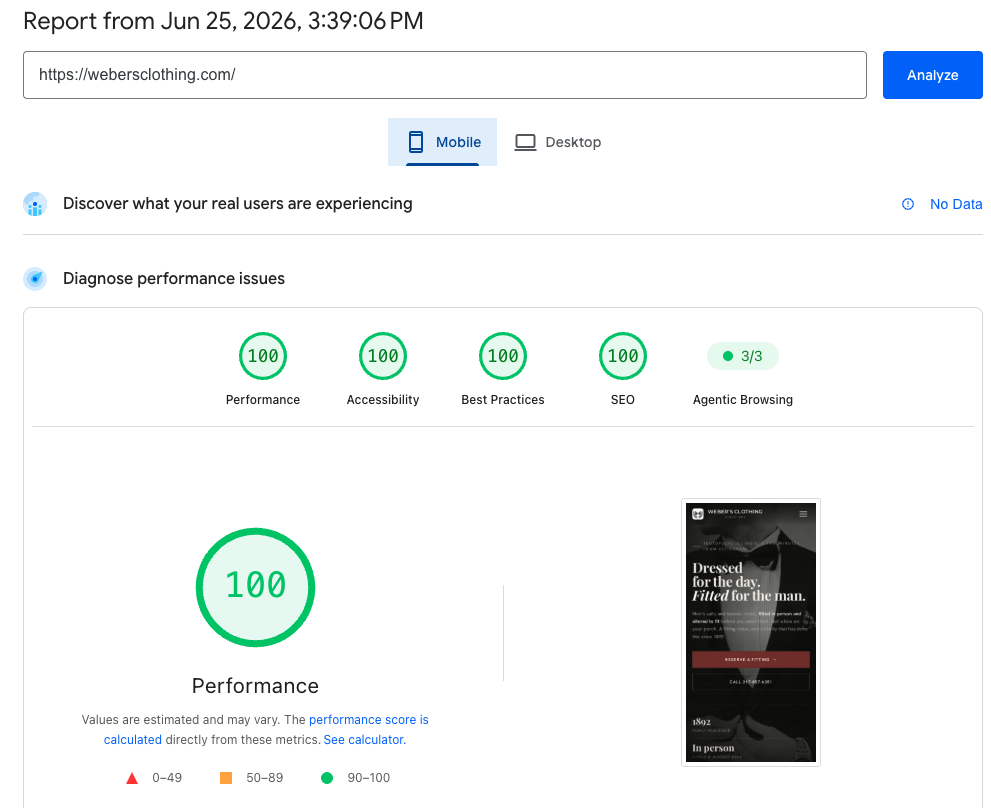
The result of that work is the score most sites never reach. Run on Google’s PageSpeed Insights, the rebuilt webersclothing.com homepage scores a perfect 100 on mobile across all four categories:
| PageSpeed category (mobile) | Score |
|---|---|
| Performance | 100 |
| Accessibility | 100 |
| Best practices | 100 |
| SEO | 100 |
That is a clean sweep on the test Google itself runs, on the device most of Weber’s customers use. Most small-business sites, and nearly every do-it-for-me template, never get a single one of those to 100.
Local SEO. This is the part Google reads, and the gap is enormous. The old site gave Google nothing. The rebuild ships a complete ClothingStore profile with the full address, map coordinates, all three sets of opening hours (Monday through Thursday 7:00 to 5:30, Friday 7:00 to 6:00, Saturday 7:00 to 1:00), the phone, the services offered, links to Facebook and Google, and the real reviews as a 4.6 out of 5 from 52 ratings. On top of that: breadcrumb markup site-wide and FAQ markup on every rental page. The robots file even welcomes AI answer engines like ChatGPT, Claude, and Perplexity, so the shop is positioned to show up in chat search, not just classic Google.
Put plainly: Google can now clearly read who Weber’s is, where it is, when it is open, what it sells, and what customers think. The old site told it none of that.
What this means if you are on a Hibu site
Weber’s is not an unusual case. It is the typical case. A do-it-for-me builder gives you a site that looks roughly fine in a thumbnail and falls apart the moment a real customer uses it. You do not own it, you cannot change it, and the parts that decide whether Google shows you, the structured data, the speed, the real photos, are exactly the parts a template skips.
The fix is not a fancier template. It is a site that is built for your store, that loads fast, that tells Google the truth about your business, and that you actually own. That is the difference between a C- and an A-, and for a local shop it is the difference between being the result people scroll past and being the one they call.
Frequently asked questions
What is wrong with a Hibu website?
Hibu builds on a do-it-for-me template platform, so you usually cannot edit your own site and every change goes through a third party. In our review of Weber’s Clothing, the template also shipped real defects: a cookie banner covering content, a broken page linked in the navigation, no structured data for Google, and stock photos instead of the real store.
Do I own my website if Hibu builds it?
Typically no. With a do-it-for-me subscription you are renting a site on the provider’s platform, and if you leave you usually cannot take it with you. Every site we build is yours to own. That ownership is the first thing we put on the table.
How much does it cost to replace a Hibu site?
We offer two paths. The Hands-Off Website is a subscription that starts at $299 a month and includes hosting, security, and edits, with us handling the work. A one-time custom build starts at $4,000 and you own and self-manage it. Both replace the rented template with something faster that you control.
Will a new website actually help me show up on Google?
We do not promise rankings, and you should not trust anyone who does. What we can do is give Google the information it needs: complete local-business structured data, fast pages, consistent name and address and phone, and real content. The old Weber’s site gave Google almost none of that, and the rebuild fixed every piece of it.
How long does a rebuild take?
Most of our sites launch in two to four weeks, depending on how much content and photography we are starting with. Weber’s went from a C- template to an A- custom site in that kind of window.
Can you keep what is good and just fix the rest?
Yes. We start every project with a free, four-angle review so we know exactly what is working and what is not. On Weber’s, the heritage, the real brand names, and two genuine customer reviews were worth keeping. We built the new site around them instead of throwing them out.
The bottom line
Weber’s Clothing spent years as a 130-year-old store hidden behind a half-finished Hibu template. Same shop, same owners, same reviews, but the website was working against them. The rebuild took it from a C- to an A- by doing the unglamorous work a template skips: real photos, a real message, a working conversion path, fast pages, and the local-business data Google needs to put a store on the map.
If you are on a Hibu, Duda, or Wix template and something about it has always felt half-finished, we will tell you exactly what we would fix, for free. Start with a free website review, or see how the Hands-Off Website works if you would rather we handle the whole thing. You can also read the full Weber’s Clothing case study for the short version.